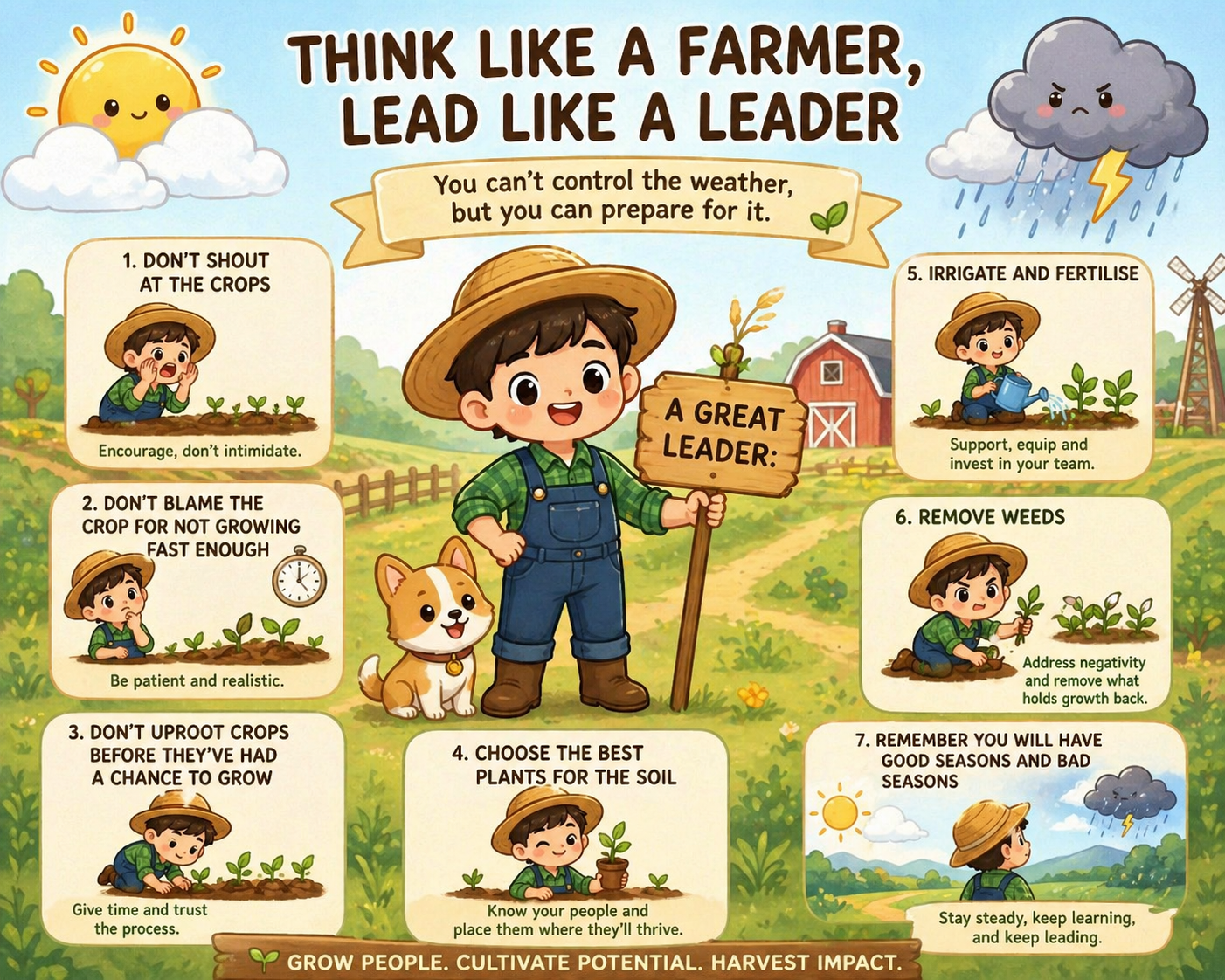
A farmer leader does not confuse control with cultivation. The work is to prepare the field, protect the conditions, and let growth compound over time.
Farmer Leader Lessons for Managers
Have you ever thought?

A farmer does not shout at crops. A farmer does not blame a seed for not becoming a tree by Friday. A farmer does not keep uprooting a plant to check whether the roots are loyal. A farmer studies soil, seasons, water, weeds, and patience.
That is also the work of leadership. Not the theatrical version where the leader is always decisive, visible, and loud. The quieter version, where a leader creates the conditions in which people can actually grow.
Leadership Is Ecological, Not Mechanical
The mistake many managers make is treating people like machines. If output is low, increase pressure. If speed is slow, increase reminders. If morale is weak, increase slogans. This can produce short bursts of compliance, but it rarely produces durable growth.
People are more like living systems. They respond to context. They need clarity, trust, resources, feedback, recovery, and a role that fits their strengths. A leader who ignores the environment will usually misread the person.
Every leadership action has a season. Click the one your team is in.
Your team is new to a role, project, or direction. Roots are forming underground. Nothing is visible yet — but everything essential is happening below the surface.
Momentum is visible. The team is producing. This is when leaders most often over-manage what is already working, or pile on new seeds when the field is already full.
Results are due. This is the time to collect, to celebrate, to account for what the season produced. Do not start new planting here. Finish what you started.
A bad quarter. A restructure. A failed initiative. Fallow land is not wasted land — it is recovering so it can produce again. Most leaders never learned this season.
tap a quarter of the wheel
A farmer does not shout at the crops.
People who are afraid of being humiliated do not take intelligent risks. They hide problems until the problems grow teeth.
Do not blame the crop for not growing fast enough means timelines must be honest. A young employee, a new team, or a fresh institution cannot be bullied into maturity. Pressure may create motion, but maturity needs repetition.
Do not uproot crops before they have had a chance to grow means stop confusing constant inspection with accountability. The need to check every root can kill the very thing one is trying to protect.
The Leader Controls Inputs Before Outcomes
One of the most useful mental models here is second-order thinking. First-order leadership asks, “How do I get faster output this week?” Second-order leadership asks, “What conditions will make better output more likely next quarter, without exhausting the field?”
The farmer’s first skill is pattern recognition. Is this thing blocking growth, or building it?
(Weed)
(Seed)
That distinction matters because teams remember the conditions under which they were asked to perform. If every season is treated like an emergency, people stop believing in seasons. Everything becomes weather. Nothing becomes strategy.
Choose the best plants for the soil means leadership is placement. A brilliant analyst may fail in a role that demands constant public persuasion. A quiet operator may become extraordinary when given systems to improve. A creative generalist may wither inside a job that rewards only compliance.
Different plants need different conditions. So does every person on your team.
Irrigate and fertilise means invest before disappointment. Support is not a reward for already thriving. It is what makes thriving possible. Training, tools, context, decision rights, and thoughtful feedback are not overhead. They are the water table.
Remove weeds means culture is not only what you add. It is also what you refuse to tolerate. Cynicism, vague accountability, credit stealing, gossip, learned helplessness, and performative urgency all compete with growth. They do not look dramatic at first. That is why they spread.
The Objection: People Are Not Crops
The obvious objection is correct. People are not passive plants. They have agency, ambition, memory, ego, and choice. A team is not a field waiting nobly for a wise farmer.
Three questions. One honest read on where your team is right now.
When you think about your team’s energy right now, which word fits best?
What does most of your management time go toward right now?
What kind of pressure are you feeling most right now?
The point is not that leaders grow people from above. The point is that leaders are responsible for the environment their authority creates. Adults still choose. But they choose inside conditions that either expand or shrink their courage.
A good leader cannot guarantee growth. They can make growth more likely. They can make honest effort safer. They can make learning visible. They can make the cost of toxicity higher than the reward. They can stop mistaking fear for discipline.
Harvest Is a Lagging Indicator
The final lesson in the image is the hardest one for ambitious leaders: remember that you will have good seasons and bad seasons. This is not a plea for complacency. It is a warning against panic.
The Garden of Intentions
Watch what happens when leaders apply the wrong intervention at the wrong time.
Bad leaders react to every bad week as if the whole field has failed. They shout, blame, uproot, reshuffle, and call the chaos urgency. Good leaders investigate without panic. They ask whether the soil is wrong, the water is missing, the season has shifted, the weeds are spreading, or the seed simply needs more time.
That is the farmer's intelligence. It is not passivity. It is patient diagnosis.
The Root System
What you see on the surface tells you almost nothing. Drag to see what is actually happening below.
← drag the slider to reveal the underground →
The leadership lesson is simple, but not easy: grow people, cultivate potential, harvest impact. In that order. The harvest comes last because it is the result of everything that came before it.
If you want better outcomes, do not only stare at the crop. Study the field you have created.
Ameya Agrawal is an IIM Kozhikode Gold Medalist, Presidential National Award recipient, and Forbes contributor. He serves as Strategy Manager at MIT World Peace University (MIT-WPU), Pune, where he leads the launch of WPU GŌA, India's first transdisciplinary residential university. He is the founder of SkillSlate, a community of 25,000+ members, and publishes open-source tools on GitHub. Follow him on LinkedIn, Twitter @ameyaagrawal, and at blog.ameya.page | GitHub


Leave a Reply