
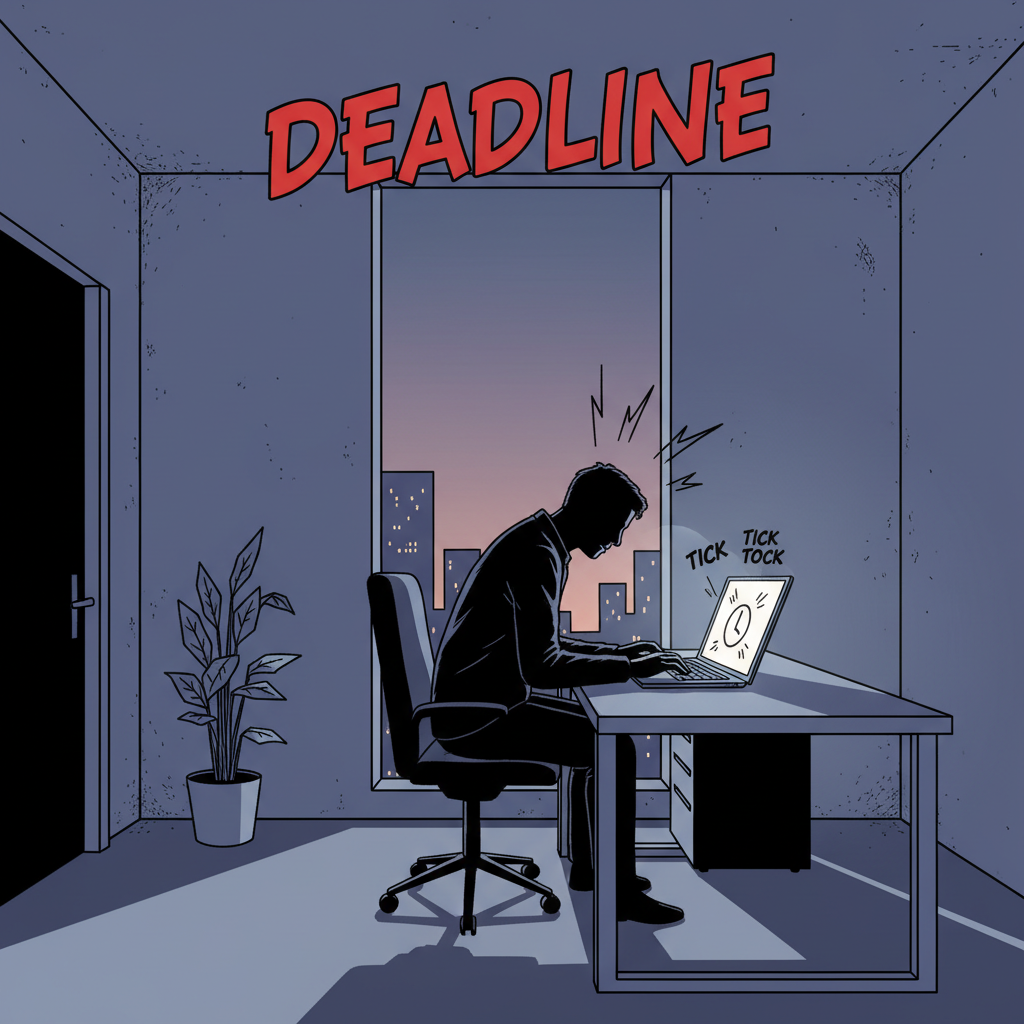
You finish a long day. The work is done, the laptop is closed, and by every reasonable measure, you’ve earned the right to switch off. And yet — your mind keeps running. The unread emails. The meeting tomorrow. The project that’s almost there but not quite. The nagging sense that resting right now means falling behind.
If this sounds familiar, you’re not alone. And more importantly, you’re not weak. High achievers struggle to switch off not because of poor discipline or bad habits, but because of how ambition rewires the brain over time. The very mental architecture that makes you effective at work makes you terrible at rest.
This post explores the psychology behind why high achievers can’t switch off — and, crucially, what the research says you can actually do about it.
The “Always-On” Brain: What’s Really Happening
To understand why switching off is so hard, you need to understand what your brain is doing when you’re not working.
Psychologists call it the Default Mode Network (DMN) — a set of brain regions that become active when you’re not engaged in a specific task. For most people, the DMN is associated with mind-wandering, daydreaming, and loose, associative thinking. It’s the brain’s version of “idle mode.”
But for high achievers, the DMN doesn’t idle. It plans.
Research published in NeuroImage found that individuals with high need for cognition — a trait strongly correlated with ambition and achievement — show significantly more goal-directed activity in the DMN during rest periods. In other words, when you stop working, your brain doesn’t switch to daydreaming. It switches to planning the next thing you should be doing.
This is partly biological, partly learned. Years of rewarding yourself with accomplishment, and penalising yourself with guilt during downtime, trains the brain to associate rest with threat — specifically, the threat of falling behind. Over time, stillness doesn’t feel neutral. It feels dangerous.
The Identity Problem: You Are What You Achieve
There’s a deeper layer here that goes beyond neuroscience. For many high achievers, the inability to switch off isn’t just habitual — it’s existential.
When achievement becomes central to your identity, rest poses a subtle but destabilising question: Who am I when I’m not producing?
Psychologist Mihaly Csikszentmihalyi, best known for his work on flow states, observed that many high performers experience genuine anxiety during leisure time — not because they dislike leisure, but because they have built an identity almost entirely around measurable output. Without a task to complete, there’s no clear signal of worth.
This is sometimes described as contingent self-esteem — a mode of self-regard where your sense of value depends on ongoing performance. The problem is that contingent self-esteem requires constant maintenance. There is no “done.” There is only the next result to chase.
Sound familiar? The inability to switch off is often less about workload and more about an underlying belief that your value expires the moment you stop working.
The Physiology of Chronic Activation
The consequences of never switching off aren’t just psychological. They’re physical — and measurable.
When the brain stays in a state of goal-directed arousal, it maintains elevated levels of cortisol, the primary stress hormone. In short bursts, cortisol is useful: it sharpens focus and mobilises energy. But chronically elevated cortisol has a well-documented downside. It impairs memory consolidation, disrupts sleep architecture, and — somewhat ironically — degrades the very executive functions that high achievers depend on.
A 2020 study in the Journal of Occupational Health Psychology found that employees who mentally detached from work during off-hours showed significantly better cognitive performance the following day than those who remained mentally engaged, even passively. The researchers used the term psychological detachment — and found it predicted next-day creativity, problem-solving quality, and emotional regulation.
The cruel irony: the high achiever who refuses to switch off because they want to perform better is, by not switching off, performing worse.
Why Rest Feels Like Quitting
Here’s a question worth sitting with: When you try to relax, do you feel lazy? Guilty? Vaguely uneasy, like you’re forgetting something important?
That feeling has a name. Dr. Alex Soojung-Kim Pang, author of Rest: Why You Get More Done When You Work Less, calls it rest guilt — a culturally reinforced belief that productivity is a moral virtue, and that rest, by contrast, is a form of moral failure.
Rest guilt is particularly acute in high-achieving contexts because ambition tends to attract competitive environments. When everyone around you is visibly working hard, stopping feels like unilateral disarmament. The social signal of being busy has become a proxy for value, competence, and commitment.
This isn’t just an individual psychology problem — it’s a cultural one. And it’s made significantly worse by smartphone technology, which has removed the natural boundaries between work and non-work time. The result: high achievers are not just working more hours. They are never fully not working. The context-switch that used to happen automatically when you left the office no longer happens at all.
What Actually Works: Evidence-Based Strategies for Switching Off
The good news is that this is a trainable skill — not a personality trait. The brain that learned to stay on can also learn to let go. But it requires deliberate practice, not just intention.
1. Scheduled Shutdown Rituals
Cal Newport, in Deep Work, describes what he calls a “shutdown complete” ritual — a fixed sequence of actions that signals to the brain that the workday is genuinely over. This might include: reviewing tomorrow’s task list, closing all tabs, writing a final note, and saying aloud “shutdown complete.”
This sounds almost comically simple. But it works because it gives the cognitive system a clear off-ramp. Without a ritual, the brain has no signal that monitoring and planning can stop. The ritual functions as a full stop at the end of a sentence — without it, the sentence keeps running.
2. Effortful Leisure (Not Passive Consumption)
One counterintuitive finding from the research: passive leisure — scrolling social media, watching TV without intention, lying on the sofa without a plan — does very little to restore cognitive resources for high achievers. In fact, for people with high need for cognition, passive leisure often increases restlessness, not decreases it.
What works better is what Csikszentmihalyi called micro-flow: leisure activities that require enough engagement to absorb attention, but don’t carry performance stakes. Reading a novel. Cooking an unfamiliar recipe. A long walk with a podcast. Playing chess. These activities occupy the goal-seeking mind with something other than work — which is the real goal of rest, not the absence of activity.
3. Decouple Rest from Productivity Justification
“I’m resting so I’ll perform better tomorrow” is a reasonable thought — and it’s backed by research. But it subtly preserves the very belief that needs to be challenged: that rest is only acceptable when it serves performance. Over time, this framing makes rest conditional, and conditions are always breakable under pressure.
The deeper psychological work is recognising that rest has intrinsic value — that a human being is not only a performance engine, and that restoration, pleasure, and stillness are legitimate ends in themselves, not just means to greater output.
4. Physical Completeness Cues
The brain responds to spatial and physical cues. Research in environmental psychology shows that working in a specific physical space — especially if that space is also your relaxation space — trains the brain to maintain alertness there, even during off-hours.
Practical implications: where possible, keep your workspace physically separate from your rest space. If you work from home, close the door to your office when the workday ends. Change clothes. Go outside, even briefly. These transitions aren’t indulgent — they’re neurological signals that it’s safe to disengage.
A Note on When Switching Off Becomes Impossible
There is a version of this that goes beyond psychology into clinical territory. If you find that the inability to switch off is causing significant distress, disrupting sleep consistently, or is accompanied by persistent anxiety that doesn’t respond to the strategies above, it may be worth speaking to a mental health professional. Burnout, anxiety disorders, and occupational stress can all present as an inability to mentally disengage from work — and are better addressed with professional support than with productivity hacks.
The Goal Isn’t Less Ambition
The inability to switch off is not a character flaw. It is the predictable result of a brain that has been trained, over years, to treat stillness as threat and output as identity. Understanding that mechanism is the first step toward changing it.
The goal isn’t to become less ambitious. It’s to become a more sustainable version of ambitious — one where rest is not the opposite of achievement, but one of its quiet preconditions.
Start with a shutdown ritual tonight. Pick one effortful leisure activity this week. And the next time rest guilt shows up, notice it for what it is: a learned belief, not a truth.
Read next:
Addicted to Progress: How Growth Culture Hijacked Happiness — on the psychology behind the relentless pressure to improve.
Where It All Begins: The Psychology of Starting Something New — on what drives us to keep going when everything feels uncertain.
Ameya Agrawal is an IIM Kozhikode Gold Medalist and Strategy Manager at the Executive Director’s Office, MIT World Peace University, working at the intersection of strategy and execution. He is a core member of the central team launching WPU GŌA, India’s first transdisciplinary residential university campus. Previously CEO of Mahatma Gandhi Seva Sangh (MGSS), his work in disability rehabilitation earned two Presidential National Awards from the Government of India, impacting over 100,000 lives across Maharashtra.
Author of the bestselling self-help book “A Leap Within” (published at age 21, earning him a National Record), Ameya has been published in Forbes, Business Standard, and The Print. He founded the SkillSlate Foundation, which trained 25,000+ individuals across 100+ organizations during the pandemic. Admitted to Harvard University in 2021, he chose to stay in India to continue his social impact work.
Technical tools and projects available on GitHub | Connect on LinkedIn | Read more at blog.ameya.page



Leave a Reply