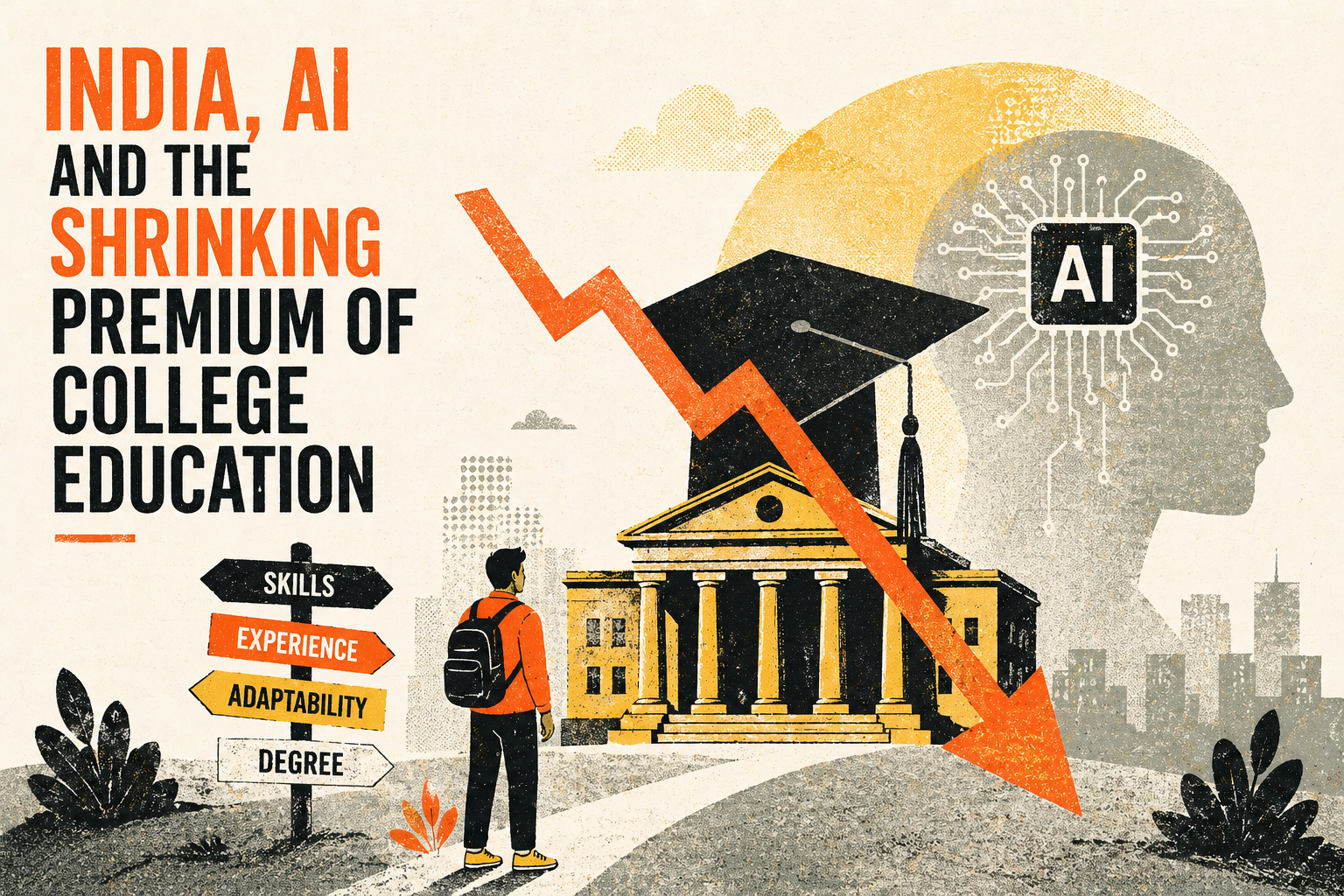
AI and college education in India are entering a more uncomfortable relationship. A degree still matters, but it no longer carries the old guarantee of mobility.
The Indian middle-class dream has always had a fairly simple instruction manual.
Study hard. Get into college. Earn the degree. Enter a respectable job. Then let the salary, the designation, and the family WhatsApp announcement do the rest.
For a long time, this bargain was imperfect but believable. A college degree was not just education. It was insurance. It was a social signal. It was the family asset that could not be stolen, divided among siblings, or eroded by a bad monsoon. Even when the system was unfair, the story still had emotional force: education would lift the next generation.
That story is now under pressure from two directions at once.
The Old Bargain
The Same Four Steps. Two Very Different Outcomes.
Click either button · scroll to auto-play
First, India is producing far more graduates than its labour market can absorb into stable, well-paying, degree-relevant work. Second, artificial intelligence is beginning to automate precisely the kind of entry-level cognitive work that allowed many graduates to prove themselves in the first place.
This is the real danger. Not that college becomes useless. That is too blunt. The danger is subtler: college may remain socially necessary while becoming economically less decisive.
That is a much more frustrating trap.
The Degree Is Still Valuable. The Old Promise Is Not.
Andy Mukherjee’s recent Japan Times essay frames the problem sharply: India’s college wage premium is shrinking at the same time that AI threatens entry-level knowledge work. According to Azim Premji University’s State of Working India 2026, graduates still earn more than non-graduates, roughly twice as much at entry. So the point is not that education has no value.
The point is that the value is becoming more uneven, more delayed, and more dependent on what kind of education we are talking about.
This distinction matters because public debate usually gets stuck between two lazy positions.
The first says: college is broken, degrees are useless, learn skills instead.
The second says: education is always good, so more degrees must mean more progress.
Both are too simple.
The Indian problem is not that too many people are educated. The problem is that too many people are being credentialed into an economy that has not created enough high-quality first jobs. A degree can still raise lifetime earnings, but it no longer does the one thing Indian families most desperately need it to do: reliably convert aspiration into a first foothold.
That first foothold is everything.
If a young person gets into a good first job, the economy starts teaching them. They learn deadlines, clients, tools, hierarchy, negotiation, quality standards, and the difference between being intelligent and being useful. If they do not get that first job, the degree begins to decay as a signal. A six-month gap becomes a one-year gap. Confidence becomes preparation. Preparation becomes waiting. Waiting becomes what India has always had a devastatingly accurate word for: timepass.
The Mental Model Is Signal Dilution
A college degree works in two ways.
It builds capability, and it sends a signal.
The capability part is obvious. Students are supposed to learn concepts, methods, habits, and ways of thinking. The signal part is less openly discussed but just as important. Employers use degrees to simplify hiring. Families use degrees to assess marriage prospects. Society uses degrees to classify ambition. Students use degrees to justify years of effort.
The problem begins when the signal grows faster than the capability behind it and faster than the economy’s ability to reward it.
That is signal dilution.
How Signal Dilution Works — Click to Add More Graduates
3 graduates in the pool. The degree is a rare, readable signal.
When very few people have a degree, the degree says something. When many people have a degree, the degree says less by itself. Employers then look for extra signals: English fluency, internships, college brand, GitHub repositories, case competitions, founder experience, referrals, portfolios, or just the confidence that comes from already belonging to the right social class.
This is why expansion without quality can become quietly regressive. It appears democratic because more people enter college. But if the labour market only rewards the top slice of institutions and networks, the degree becomes a ticket to a lottery with better odds for those who were already closer to the front of the queue.
AI makes this problem sharper because it attacks the lower rungs of the professional ladder.
Entry-level work has always included a lot of routine cognition: summarizing documents, checking code, preparing decks, writing first drafts, cleaning data, doing basic research, making spreadsheets, answering standard customer questions, and producing the first version of something that a senior person improves.
This work was never glamorous. But it was educational. It gave young graduates a place to be imperfect inside the economy.
AI is making that space smaller.
Entry-Level Work — What AI Is Taking, What It Cannot
These six tasks are where graduates used to learn by doing. If they disappear from first jobs, the judgment in the bottom three rows never develops — because it forms through supervised imperfection, not through watching.
What Happens When the First Draft Disappears?
Every profession has a version of the first draft.
The junior lawyer reads the file and prepares the first note. The analyst builds the first model. The trainee engineer debugs the obvious issue before escalating the real one. The marketer writes the rough campaign options. The consulting associate makes the first messy deck. The software fresher fixes small bugs before understanding architecture.
This is how judgment is formed. Not through abstract training alone, but through supervised imperfection.
AI tools are already good at many of these first-draft tasks. They can write code, find bugs, summarize documents, generate options, produce research briefs, and create presentations that look more finished than a fresher's first attempt. For employers under cost pressure, the temptation is obvious: hire fewer entry-level workers, give AI to the mid-level employees, and let the existing team produce more.
That may improve short-term productivity. It may also damage the talent pipeline.
Because if young people do not get to do the basic work, they do not automatically become capable of advanced work. The ladder does not become more efficient when the bottom rungs disappear. It becomes harder to climb.
The Missing Rungs
Remove each rung. See what disappears with it.
The yellow rungs are where AI is taking over. Click each one to see why — then remove it.
This is the part of the AI jobs debate that still feels underdeveloped. We talk as if tasks exist independently. Automate the task, save the cost. But tasks also train people. The spreadsheet is not just a spreadsheet. It is how someone learns the business. The bug fix is not just a bug fix. It is how someone learns the codebase. The client note is not just a note. It is how someone learns what clients actually care about.
When AI absorbs the training tasks, organizations need a new apprenticeship model. Otherwise they will solve today's productivity problem by creating tomorrow's capability shortage.
Why This Is Especially Dangerous for India
India is not facing this transition from a position of labour-market comfort.
The State of Working India 2026 report highlights a difficult education-to-employment transition. Graduate unemployment among young people remains painfully high, and the working-age population share is expected to begin declining after 2030. That gives India a narrow window to convert its demographic dividend into actual economic strength.
The timing matters.
If AI had arrived after India had built a deep manufacturing base, broad formal employment, and a strong apprenticeship culture, the shock would be different. Workers displaced from one type of routine cognitive work could move into a wider set of productive sectors.
But India's growth model has leaned heavily on services, especially software and business-process work. These sectors created powerful mobility for a slice of the population. They also shaped the imagination of Indian higher education. Engineering colleges, coding bootcamps, MBA programmes, analytics certificates, and placement cells all grew around the belief that the service economy could keep absorbing educated youth.
Now the service economy itself is being re-priced by AI.
This does not mean India's IT sector collapses. Strong firms will adapt. High-skill workers will become more productive. New companies will be created. But the mass entry-level opportunity that carried so much middle-class hope may become narrower and more competitive.
That is where the social risk sits.
When education expands but opportunity does not, frustration does not remain private. It changes politics, family decisions, migration patterns, marriage markets, and trust in institutions. A country can survive unemployment among the uneducated by telling a story of future education. It is much harder to manage unemployment among the educated, because the educated unemployed have already done what society asked them to do.
Their disappointment carries a moral charge.
The Necessary Counterargument
A serious argument has to admit what college still does well.
College is not only a placement machine. At its best, it gives young people time to mature, meet peers, encounter ideas, build confidence, learn how to learn, and leave the narrowness of their inherited world. Even a flawed college can expand aspiration. Even an imperfect degree can protect someone from worse outcomes.
The data also does not support a simplistic anti-college conclusion. Graduates still earn more than non-graduates. The premium has not vanished.
But the premium is no longer enough to justify complacency.
The right question is not, "Is college worth it?" The right question is, "What kind of college is worth it now?"
The Evidence Gap
Two graduates. Same degree. Very different answers to "show me what you can do."
Think of hiring a plumber. You can either trust the framed certificate on their wall — or actually see the pipes they have fixed. Click each icon to add real evidence to the right side.
Click each piece of real work:
Click icons one by one to build the evidence profile
A college that only transfers content is in trouble because content has become abundant. A college that only conducts exams is in trouble because exams are a weak proxy for work. A college that only promises placements is in trouble because placements depend on macroeconomic realities no institution fully controls.
The college that survives this transition has to do something harder.
It has to become a structured environment for capability formation.
What Higher Education Must Become
The future premium will not attach to the degree alone. It will attach to evidence.
Evidence that a student can think across domains.
Evidence that they can use AI without outsourcing judgment.
Evidence that they can communicate clearly, build with others, handle ambiguity, and produce work that survives contact with the real world.
Evidence that they have done something more demanding than pass a semester exam.
This means universities need to redesign around four shifts.
First, from curriculum to capability. The unit of design should not only be the course. It should be the graduate's demonstrated ability to solve problems, create value, and keep learning after the syllabus ends.
Second, from placements to pathways. A placement cell cannot be the only bridge between college and work. Students need internships, live projects, field immersion, maker labs, founder tracks, research studios, and employer-linked challenges from the first year onward.
Third, from AI avoidance to AI fluency. Banning AI in assignments may feel morally satisfying, but it prepares students for a world that no longer exists. The real task is to teach students when to use AI, when to distrust it, how to verify it, and how to add judgment above it.
Fourth, from disciplinary silos to transdisciplinary work. Real problems do not arrive as engineering, management, design, psychology, public policy, or sustainability. They arrive tangled. The student who can move across domains without becoming shallow will carry a stronger signal than the student who only knows how to reproduce one discipline's language.
This is where the future of higher education becomes less about more degrees and more about better environments.
Where WPU GŌA Can Fit In
This is also where a new university has an unusual opportunity.
WPU GŌA, a new residential university starting this year in Goa aims to tackle challenges in the Indian labor market. As the market evolves with AI and unclear job pathways, WPU GŌA is designed to focus on clear signals from the start, avoiding old institutional structures.
If the Indian labor market is moving toward signal dilution, AI-mediated work, and uncertain entry-level pathways, then a new design like WPU GŌA has to be built around stronger signals from the beginning.
The question should not be: how do we give students a degree and then help them find jobs?
The question should be: how do we make education produce visible, credible, hard-to-fake evidence of capability?
The Four Shifts
Think of these like settings on a phone. Most universities still run all four on the old default.
Tap each switch to flip it from old to new. See what the degree becomes when all four are on.
Tap each switch individually · or switch all at once
That means every student should graduate with more than a transcript. They should graduate with a body of work: projects, prototypes, research, field immersions, venture attempts, community work, AI-enabled portfolios, and reflective evidence of how their thinking has changed.
A university like WPU GŌA useful here because AI rewards people who can connect contexts. The narrow task may be automated. The broader problem still needs framing. Someone has to decide what is worth building, who it affects, what trade-offs matter, what the data misses, how the user behaves, how the business model works, and what ethical line should not be crossed.
Those are not single-discipline questions.
As much learning can happen online, a residential university facilitates rebuilding apprenticeships in a different form. If students live, work, build, debate, and collaborate in the same environment, learning is not limited to classroom hours. The campus itself becomes a social technology. Peer learning, faculty mentorship, clubs, studios, labs, and community life can create the repeated practice that AI may remove from entry-level jobs.
The labour market will increasingly reward young people who have already practiced judgment before their first job. Not just knowledge. Judgment. Not just fluency. Judgment. Not just AI usage. Judgment over AI usage.
That should be the promise of a serious new university.
The Degree Must Become Harder To Fake
India does not need to give up on higher education. It needs to make higher education more honest.
The old system treated the degree as the signal. The new system has to treat the degree as a container for signals. What did the student build? What did they improve? What did they understand deeply? What can they do with other people? How do they behave when the answer is not in the back of the textbook? How do they use machines without becoming intellectually dependent on them?
The college premium is shrinking because the market is becoming less willing to pay for weak signals. AI will accelerate that. It will make average work easier to produce and harder to trust. It will make polished output less impressive. It will push employers to ask for proof.
That sounds harsh, but it can also be clarifying.
The future of Indian higher education is not less education. It is more demanding education.
Education that does not hide behind attendance, exams, and placement brochures.
Education that creates capability before it claims employability.
Education that gives young people the one thing AI cannot give them automatically: a practiced sense of judgment formed through real work, real feedback, real failure, and real responsibility.
The middle-class dream does not need to die. But it does need a new instruction manual.
Study hard is no longer enough.
Get the degree is no longer enough.
The new bargain has to be harder, clearer, and more honest:
Build evidence. Practice judgment. Learn with machines. Work across domains. Make your education visible in the quality of what you can actually do.
That is the premium worth rebuilding.

Ameya Agrawal is an IIM Kozhikode Gold Medalist, Presidential National Award recipient, and Forbes contributor. He serves as Strategy Manager at MIT World Peace University (MIT-WPU), Pune, where he contributes for the launch of WPU GŌA, India's first transdisciplinary residential university. He is the founder of SkillSlate, a community of 25,000+ members, and publishes open-source tools on GitHub. Follow him on LinkedIn, Twitter @ameyaagrawal, and at blog.ameya.page | GitHub

Leave a Reply